
5 Things to Decide Before Building a B&B Website
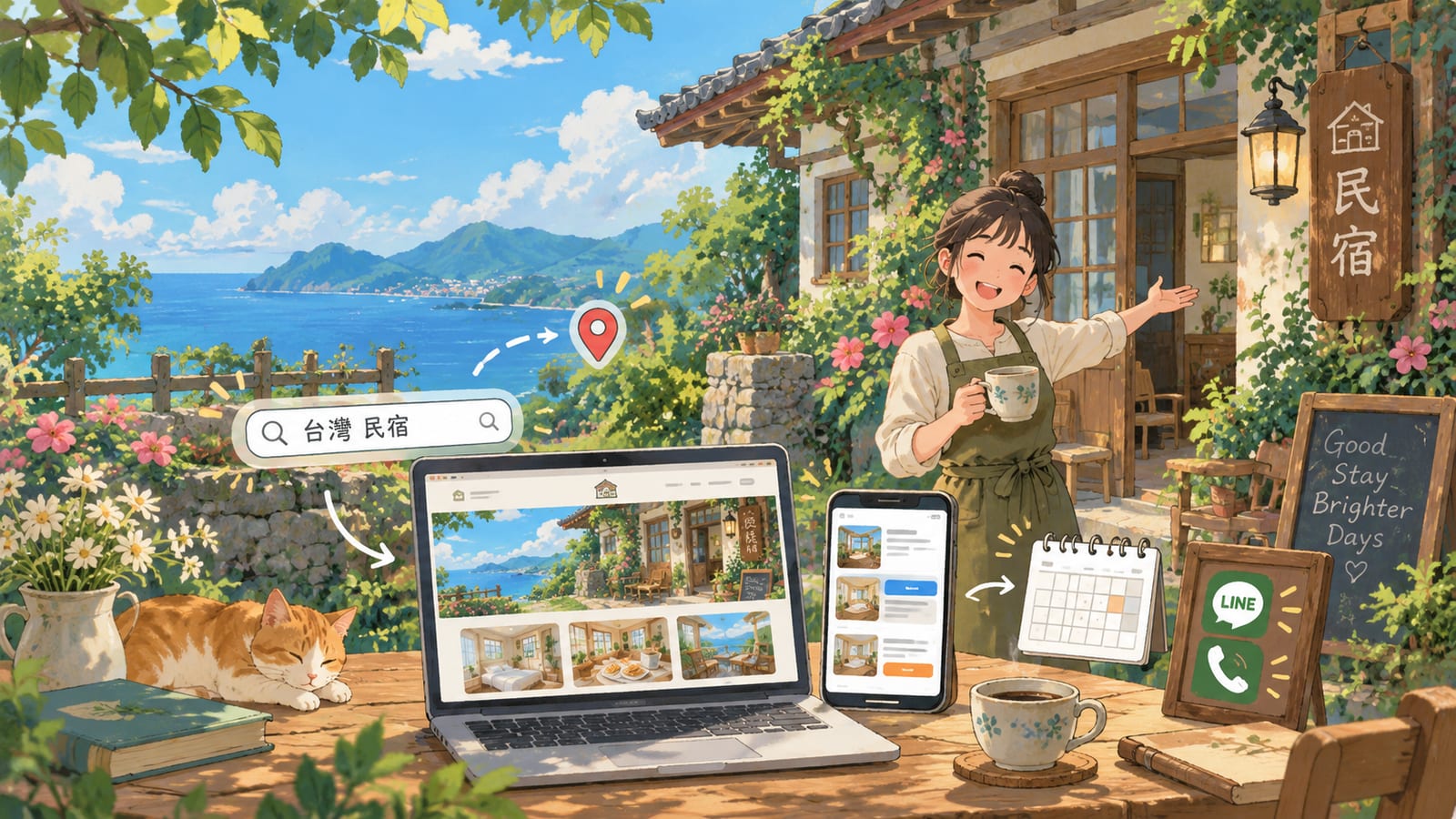
A good share of your B&B bookings probably come from Booking.com, Agoda and Airbnb.
These platforms are called OTAs (Online Travel Agencies). They showcase your rooms, take bookings and handle payment, and charge you a commission or service fee in return.
Many B&Bs were built on OTAs, so owners often ask:
"All my bookings are on the platforms already. Do I still need my own website?"
Yes — but first be clear about what the website is for.
Your website is not there to replace the OTAs
For most small and mid-sized B&Bs, the website's main job is not to replace Booking or Airbnb, but to do what the platforms cannot.
On an OTA, travellers see many properties side by side and compare price, rating, location and room type.
What actually makes you special — the design of the space, your philosophy, the sights nearby, the kind of guest you suit — is hard to show there in full.
Your website can tell that story properly, and it can list your LINE, phone number and directions too.
So the real value of the website is:
Letting travellers get to know you and trust you before they decide to book.
It is perfectly fine if they go back to an OTA to book in the end.
A good-looking site does not mean Google can find it
A B&B website has another important job: being understandable to search engines.
At the very least, pay attention to two things.
First, your Google Business Profile and your website must say the same thing.
Name, address, phone number and website URL should all be correct and complete.
Second, the site cannot just look good — it needs basic SEO structure.
For example page titles, room content, the mobile version, site speed and a sitemap.
These are best handled while the site is being built, not patched in afterwards.
Three things that really drive the price
1. Do you need your own booking system?
If travellers should pick dates, book and pay directly on your site, you are dealing with room inventory, pricing rules, orders, payments and notifications.
That costs far more than a typical brand website.
But if your guests already book through Booking, Agoda or Airbnb, the most practical approach is usually:
Let the website introduce you and send guests onward, and leave booking to the OTAs — or to LINE and phone enquiries.
2. How is room availability updated?
There are three common approaches:
- Switching "available / full" by hand in an admin panel
- Syncing booked dates from the OTA calendars
- Integrating with a PMS, a channel manager or a booking system
They all look like "showing availability", but the technology and the price behind them are completely different.
So confirm this before asking for a quote.
3. What costs are there beyond the website?
Besides development, make sure you know:
- Who provides the room photos
- Who writes the copy
- Who manages the domain and hosting
- Who handles ongoing maintenance and backups
Also, if you run a licensed B&B in Taiwan, check the rules on publishing accommodation information online, such as displaying your B&B registration number.
Answer these 5 questions before you build
- Is the website for introducing your brand, or for taking bookings directly?
- Is your Google Business Profile in order?
- Will availability be updated by hand or synced automatically?
- Who is responsible for photos, copy, the domain and hosting?
- Is your B&B registration information ready?
Once you have answers to these five, it becomes much clearer what features the site needs and roughly what it should cost.
A B&B website does not have to be complicated.
What matters is spending money where guests will actually use it, where the owner can manage it, and where it genuinely brings in enquiries and bookings.
Most travellers find B&Bs and browse rooms on their phones, so how well your site works on mobile directly affects whether they stay: